Deep in the jungles of Vietnam, a man searching for a way to feed his family stumbled upon something that would eventually astonish the entire world.
It was 1990, and Hồ Khanh was making his way through the dense forests of central Vietnam when a powerful thunderstorm forced him to seek shelter.
As rain poured through the jungle, he noticed a dark opening beneath a towering limestone cliff.
At first, it appeared to be nothing more than another cave entrance.
But then he heard something strange.
A deep, thunderous roar was coming from somewhere inside the mountain.
Cold air rushed out of the opening, carrying thick clouds of mist.
The sound was so powerful that it seemed as though an enormous waterfall was hidden deep underground.
Hồ Khanh approached cautiously.
He could not see what lay beyond the entrance.
The opening descended steeply into darkness, and without proper equipment, exploring it would have been extremely dangerous.
So he made a decision that would delay one of the greatest discoveries in modern exploration for almost two decades.
He walked away.
What he did not know was that he had just discovered the entrance to Hang Sơn Đoòng, the largest known cave passage on Earth.
And the extraordinary world hidden inside would eventually leave even experienced explorers speechless.
A Mysterious Sound in the Vietnamese Jungle
The story begins in the mountainous region of Phong Nha-Kẻ Bàng, in central Vietnam.
The landscape is covered with thick tropical forests, steep limestone mountains, and countless hidden caves.
For generations, local people had ventured into these forests searching for food, timber, and valuable natural resources.
Hồ Khanh was one of them.
Born in 1969, he grew up in a rural community where making a living was often difficult.
As a young man, he spent long periods exploring the jungle.
He searched for valuable agarwood and other forest products that could be sold to support his family.
These journeys required considerable knowledge of the landscape.
He learned to recognize mountain formations, rivers, valleys, and natural landmarks.
But even someone familiar with the forest could easily become disoriented in such remote terrain.
During one of these expeditions in December 1990, a thunderstorm swept across the mountains.
Hồ Khanh searched for somewhere to escape the rain.
That was when he discovered the unusual opening in the limestone cliff.
As he approached, he felt an unusually strong current of cold air.
Mist drifted from the darkness.
And somewhere far below, he could hear the unmistakable sound of rushing water.
It was clear that this was no ordinary hole in the rock.
Something enormous was hidden inside.
Why He Was Too Afraid to Enter
The entrance was not particularly inviting.
Unlike the wide, easily accessible openings of some tourist caves, this one led down a steep and dangerous slope.
Beyond the visible rocks, the passage disappeared into darkness.
Hồ Khanh had no ropes, specialized lighting, or climbing equipment.
He was alone.
And the roaring sound suggested that a powerful underground river might be flowing beneath him.
Entering would have been an enormous risk.
The strong wind and mist also made the place seem mysterious.
Although these phenomena have natural explanations, they were unsettling to someone standing alone in the jungle.
He decided not to investigate.
Instead, he continued his journey and eventually returned home.
At the time, he had no reason to believe that the cave would become internationally famous.
He had encountered numerous caves during his years in the forest.
This seemed like another unusual feature of the landscape.
As the years passed, he gradually lost track of its exact location.
And one of the most remarkable natural wonders on Earth remained hidden.
The Cave That Disappeared for Nearly 20 Years
During the 1990s, British cave explorers were conducting expeditions throughout the Phong Nha-Kẻ Bàng region.
The area was already famous for its extraordinary limestone formations and extensive underground waterways.
Explorers had discovered enormous caves, including Hang Én.
But something about the underground river system puzzled them.
Water disappeared into the limestone mountains at certain locations, suggesting that undiscovered passages existed farther underground.
The explorers suspected that a major cave system remained hidden somewhere in the forest.
Yet finding an entrance was extraordinarily difficult.
The jungle was dense.
The terrain was rugged.
And many of the most promising areas were several days’ walk from established settlements.
The team spent years searching without success.
Then they heard an intriguing story.
A local man named Hồ Khanh claimed that he had once found a cave with powerful winds and a roaring underground river.
For experienced cave explorers, those details were extremely important.
A strong current of air could indicate a substantial underground passage.
The sound of flowing water suggested that the opening might connect to the mysterious river system they had been trying to locate.
Suddenly, Hồ Khanh’s forgotten discovery became the focus of an international search.
A Search Through the Wilderness
British cave explorer Howard Limbert and his colleagues encouraged Hồ Khanh to find the entrance again.
But there was a problem.
Almost two decades had passed since he first discovered it.
The jungle had changed.
Vegetation had grown.
And the surrounding mountains contained countless similar cliffs and valleys.
Hồ Khanh remembered the strange wind and the roaring water.
But he could not immediately identify the exact location.
He began searching the forest again.
There were unsuccessful attempts.
Long journeys through difficult terrain.
And moments when it seemed that the mysterious entrance might never be found.
But Hồ Khanh continued looking.
In 2008, his persistence finally paid off.
During another journey through the jungle, he rediscovered the opening.
The same cold air emerged from the darkness.
The same sound of rushing water echoed from somewhere below.
This time, he carefully noted the route and surrounding landmarks.
He was determined not to lose it again.
When the British explorers returned in 2009, he was ready to lead them to the entrance.
None of them yet understood the extraordinary scale of what they were about to discover.
April 7, 2009: The Day Everything Changed
On April 7, 2009, a team of cave explorers reached the entrance with Hồ Khanh as their guide.
The expedition included members of the British-Vietnamese cave exploration effort.
Unlike Hồ Khanh’s first visit, the explorers carried ropes, helmets, lights, and specialized surveying equipment.
They were prepared to descend into the darkness.
Peter MacNab was the first member of the expedition to enter the cave.
The team carefully made its way down the steep entrance.
At first, the surroundings resembled other limestone caves they had explored.
But as they progressed, the scale of the passages began to change.
The walls rose higher.
The ceiling seemed to disappear into darkness.
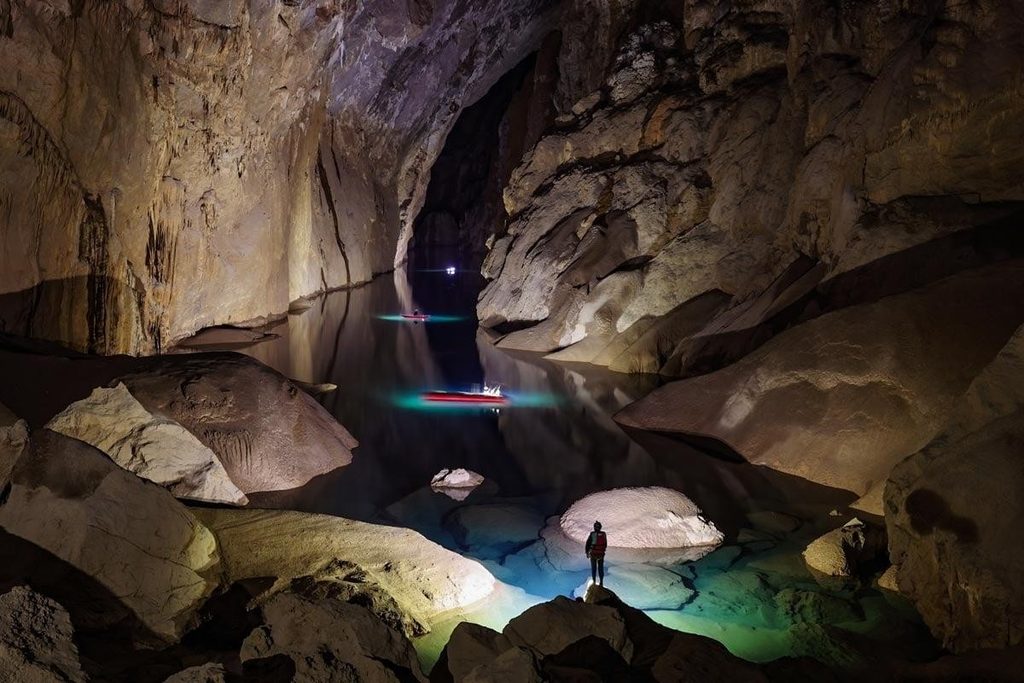
And the spaces became so enormous that ordinary cave lighting could not illuminate their full dimensions.
The explorers had entered something extraordinary.
What had appeared from outside to be a relatively modest opening was actually the entrance to a vast underground world.
And the farther they traveled, the more astonishing it became.
A Cave So Enormous It Could Swallow Skyscrapers
As the expedition continued, the explorers began measuring the underground passages.
Their instruments revealed dimensions that seemed almost impossible.
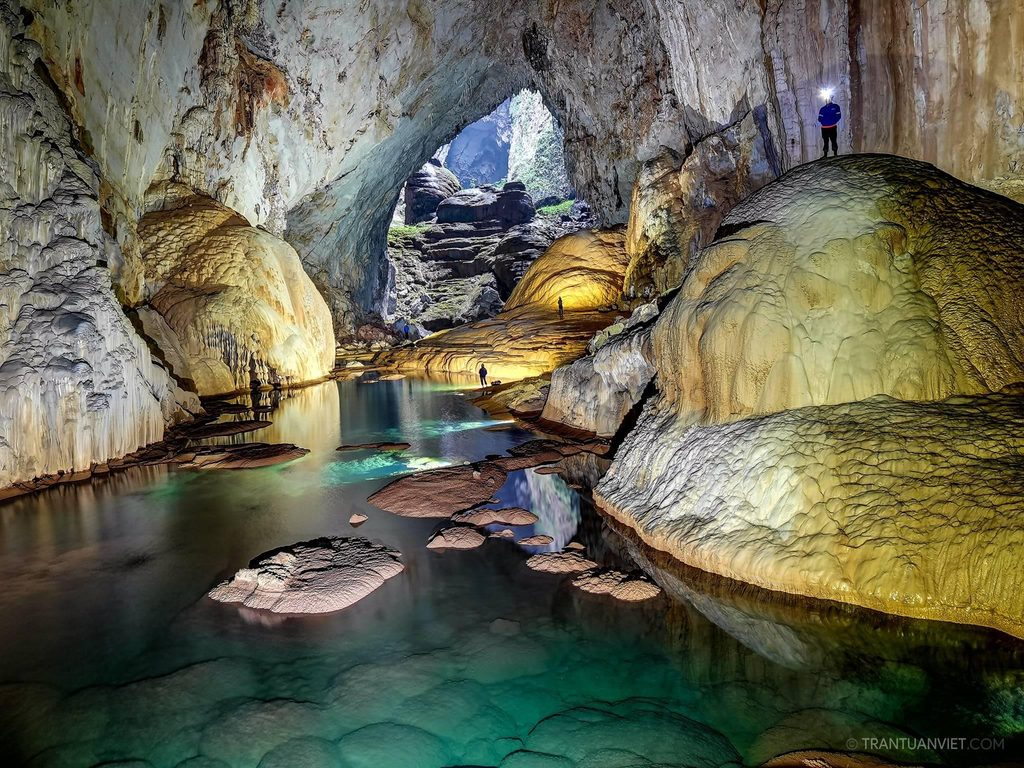
Some sections of Hang Sơn Đoòng are approximately 200 meters high and 150 meters wide.
That is roughly 656 feet tall and 492 feet wide.
To understand the scale, imagine standing at the bottom of a space large enough to accommodate a 40-story building.
Now imagine that enormous chamber continuing through a mountain for kilometers.
That is the scale of Sơn Đoòng.
The cave’s surveyed system extends for nearly nine kilometers, while its enormous main passage holds tens of millions of cubic meters of space.
It is recognized by Guinness World Records for having the largest known single cave passage.
For the explorers, the measurements confirmed that they were dealing with a discovery of global significance.
But the cave’s size was only the beginning.
Deep inside, they encountered features that seemed almost too beautiful to be real.
A Hidden River Flowing Through the Mountain
The mysterious roaring sound that Hồ Khanh heard in 1990 finally had an explanation.
An underground river flows through parts of Sơn Đoòng.
Over immense periods of geological time, water has helped shape the limestone landscape.
Rainwater absorbs carbon dioxide and becomes slightly acidic.
As it travels through cracks in limestone, it gradually dissolves the rock.
Over thousands and millions of years, small fractures can expand into passages.
Those passages can eventually become enormous underground chambers.
In Sơn Đoòng, the process created one of the most spectacular cave systems ever discovered.
The underground river continues moving through the darkness.
Its sound echoes against the walls.
During periods of heavy rainfall, water levels can rise dramatically.
This makes exploration dangerous and requires careful planning.
But the river is also one of the most remarkable features of the cave.
It is a powerful reminder that landscapes continue changing even when they are hidden beneath the surface.
The Moment Explorers Discovered a Jungle Underground
Perhaps the most extraordinary feature of Sơn Đoòng is that parts of the cave contain living forests.
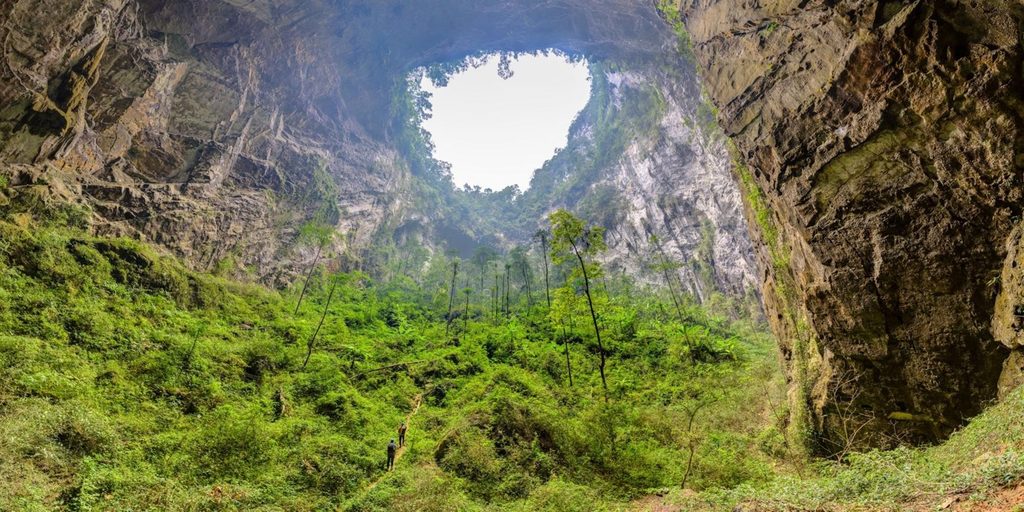
Deep inside the mountain, explorers discovered enormous openings in the ceiling.
These openings formed when sections of the cave roof collapsed.
Geologists call them dolines.
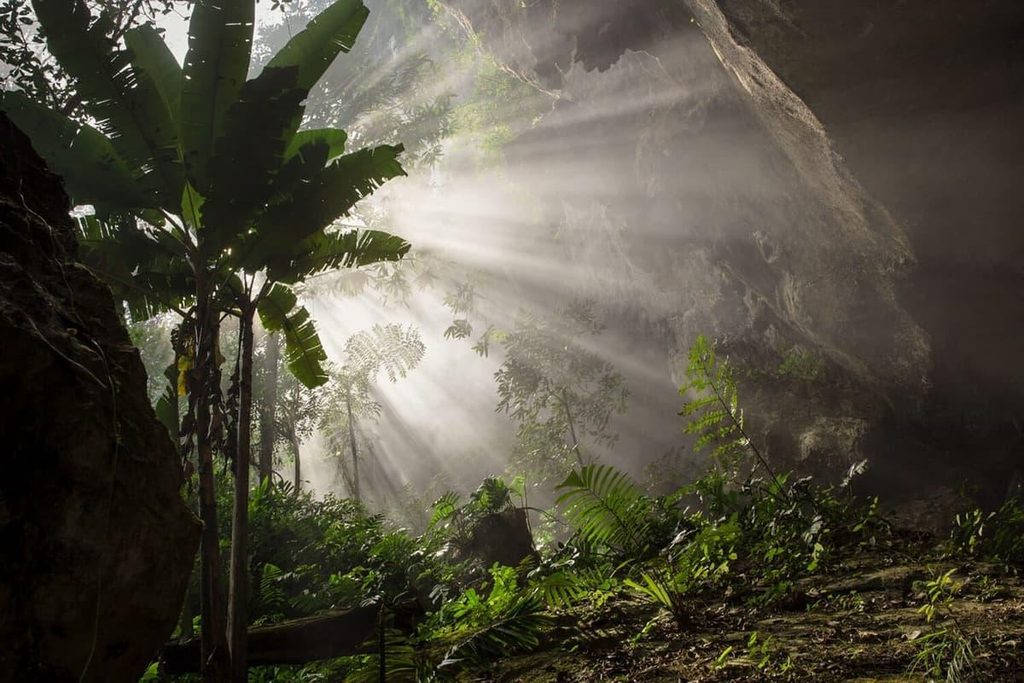
Through these natural skylights, sunlight pours into the underground world.
And wherever enough light reaches the cave floor, plants can grow.
Over time, these illuminated areas developed their own vegetation.
Trees rise from the ground.
Ferns cover the rocks.
Moss grows across damp surfaces.
And sunlight filters through leaves in a scene that resembles an ordinary tropical forest.
Except this forest is inside a mountain.
One of these extraordinary areas is known as the Garden of Edam.
For visitors, reaching this section can feel like stepping into a completely different world.
After hours surrounded by darkness and stone, they suddenly encounter greenery and natural light.
The contrast is breathtaking.
It is one of the reasons Sơn Đoòng is considered among the most spectacular natural places on Earth.
A World With Its Own Clouds and Mist
The cave’s enormous dimensions create unusual atmospheric conditions.
Moisture from underground water and the surrounding environment can produce mist and cloudlike formations inside the chambers.
Temperature differences and moving air contribute to these effects.
The result can be astonishing.
Clouds of vapor drift through enormous underground spaces.
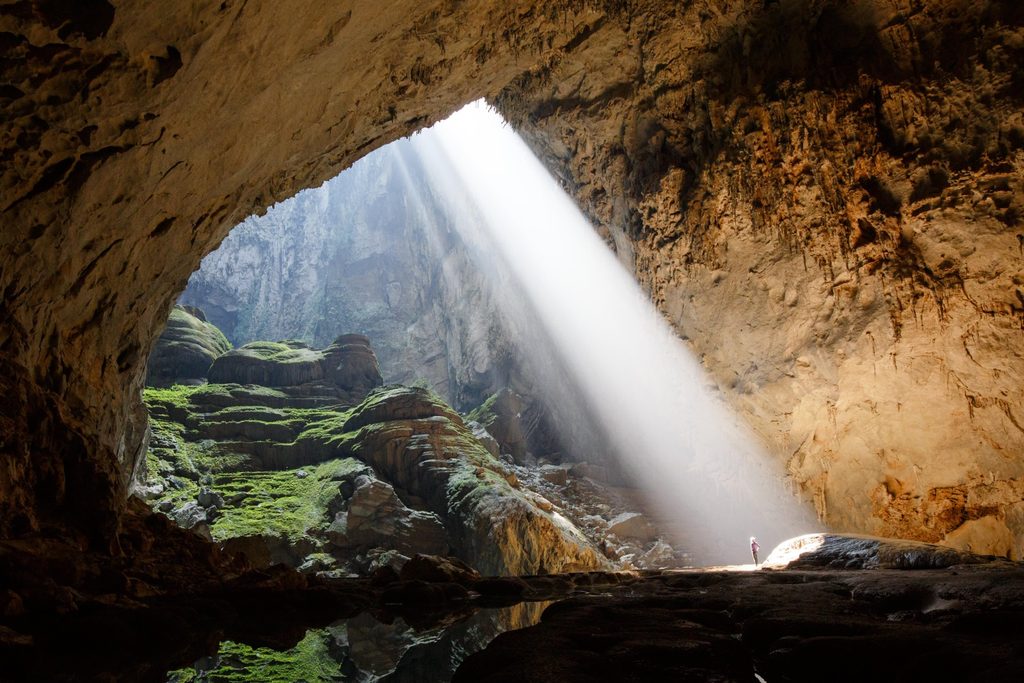
Sunlight enters through openings high above.
And beams of light cut through the mist, illuminating sections of the cave floor.
Photographs of these scenes often look like images from a fantasy movie.
Tiny explorers stand beneath enormous rock formations.
Clouds hover between walls of stone.
And distant sunlight makes the underground landscape appear almost otherworldly.
But these scenes are real.
They are the result of geology, water, air movement, and light interacting inside an extraordinarily large cave.
For photographers, the conditions provide some of the most dramatic natural images imaginable.
For scientists, they offer an opportunity to study a remarkable underground environment.
Giant Stalagmites Rise From the Cave Floor
Another extraordinary feature of Sơn Đoòng is its collection of enormous cave formations.
Water dripping through limestone can deposit minerals over long periods.
As mineral-rich droplets reach the cave floor, they may gradually build upward-growing formations known as stalagmites.
Similar deposits hanging from ceilings are called stalactites.
In many caves, these formations are relatively small.
But inside Sơn Đoòng, some stalagmites reach astonishing heights.
Certain formations rise more than 70 meters above the cave floor.
They resemble enormous stone towers.
Their surfaces record a history of mineral deposition that developed over immense periods.
Walking among them can make people feel incredibly small.
A human being standing beside one of these formations may appear no larger than a tiny figure.
The scale is difficult to appreciate until it is compared with something familiar.
And even then, photographs struggle to capture the full experience.
The Great Wall of Vietnam
During the first major exploration in 2009, the team eventually encountered an enormous obstacle.
A towering calcite formation blocked their route.
It rose approximately 90 meters high.
The explorers named it the Great Wall of Vietnam.
The wall was so steep and imposing that the team could not safely climb it with the equipment available during that expedition.
They had already traveled through some of the largest underground passages ever documented.
But now they were stopped by a massive natural barrier.
They had to turn back.
The unexplored area beyond the wall remained a mystery.
In March 2010, the explorers returned with specialized climbing equipment.
This time, they successfully climbed the formation.
Beyond it, they continued surveying the cave and eventually reached another exit.
The expedition helped complete the mapping of the enormous system.
The discovery was even more impressive than researchers had initially imagined.
The Cave Becomes a World Record Holder
After the surveys, researchers compared Sơn Đoòng with other major caves around the world.
They examined its dimensions, passage size, and overall volume.
The results established it as the largest known natural cave passage by volume.
Guinness World Records recognized Hang Sơn Đoòng as the world’s largest single cave passage.
The distinction is important.
Other cave systems are longer when their networks of tunnels are added together.
But Sơn Đoòng stands apart because of the immense size of its main passages.
Its scale is almost impossible to communicate through ordinary measurements.
In some sections, a large passenger aircraft could fit within the underground space.
Elsewhere, the chambers are tall enough to contain enormous buildings.
The cave is not merely a tunnel through a mountain.
It is an underground landscape on a scale that few people had imagined possible.
And all of it remained unknown to modern cave science until the early twenty-first century.
An Underground Ecosystem Unlike Any Other
Sơn Đoòng is not simply a collection of empty chambers.
Its different environments support living organisms.
The illuminated dolines provide conditions for plants and animals associated with the surrounding forest.
Other areas remain permanently dark.
These sections support organisms adapted to cave environments.
Scientists have studied bats and other animals in the system.
The cave’s combination of underground rivers, large chambers, forest openings, and isolated habitats makes it particularly interesting for biological research.
Each environment presents different conditions.
Some are humid and dark.
Others receive direct sunlight.
And some experience dramatic changes in water levels during the rainy season.
Studying these habitats helps researchers understand how organisms survive in unusual environments.
It also highlights the importance of protecting the cave from excessive human disturbance.
How Did Such an Enormous Cave Form?
The formation of Sơn Đoòng began long before humans existed.
The limestone mountains of central Vietnam developed through geological processes extending over millions of years.
As the landscape changed, water gradually entered fractures in the rock.
Over time, flowing water enlarged those fractures.
Small passages became larger.
Underground rivers carved channels through the limestone.
And sections of rock eventually collapsed, creating enormous chambers and openings.
The result is the spectacular underground system visible today.
Scientists continue studying the region’s geological history.
The cave offers clues about the movement of water, the development of limestone landscapes, and environmental changes over time.
Its enormous chambers are the product of natural processes operating on timescales far beyond a human lifetime.
What Hồ Khanh discovered during a thunderstorm was the visible entrance to a geological story millions of years in the making.
Why the Cave Remained Hidden for So Long
It may seem unbelievable that a place this enormous could remain unknown to the wider world until 2009.
But the answer lies in its location.
Sơn Đoòng is hidden within a remote mountain landscape covered by dense jungle.
Its entrance is difficult to find.
Reaching it requires navigating rugged terrain.
And entering safely requires specialized equipment.
The cave’s extraordinary dimensions are not visible from outside.
A person passing through the forest could walk relatively close to the entrance without realizing what lies beneath the mountain.
Even after Hồ Khanh discovered the opening in 1990, he struggled to locate it again.
For scientists, this illustrates an important reality.
The Earth still contains places that are difficult to access and incompletely explored.
Modern technology has mapped much of the planet’s surface.
But underground environments remain challenging.
Sơn Đoòng is one of the most remarkable examples of what can remain hidden in plain sight.
From an Unknown Forest Worker to a Famous Explorer
Hồ Khanh’s life changed dramatically after the discovery became internationally recognized.
For years, he had worked in the jungle to support his family.
His knowledge of the landscape came from practical experience rather than formal scientific training.
But that knowledge proved essential.
Without his memory of the unusual entrance, the British explorers might have spent many more years searching.
His persistence made the expedition possible.
After the discovery, Hồ Khanh became closely involved in cave exploration and tourism.
He worked with expedition teams and helped organize the logistics needed for journeys into the region.
He also continued assisting researchers in locating other caves.
His story demonstrates the importance of local knowledge in scientific discovery.
The explorers brought specialized equipment and technical expertise.
But Hồ Khanh knew the forest.
Together, they accomplished something extraordinary.
The World Finally Sees What Was Hidden Inside
As photographs and documentaries began appearing, Sơn Đoòng attracted international attention.
The images were unlike anything most people had seen.
Enormous chambers filled with mist.
Underground rivers flowing through darkness.
Towering stone formations.
And lush green forests illuminated by sunlight entering through the mountain.
Photographers captured scenes in which explorers looked almost microscopic against the cave walls.
The photographs helped communicate the scale of the discovery.
They also introduced audiences to a landscape that had previously been known only to a small number of explorers.
National Geographic helped bring the cave to international attention.
Documentary crews and photographers followed expeditions into the underground passages.
Their work revealed one of the planet’s most extraordinary natural environments.
For people viewing the images from home, it was difficult to believe that such a place existed beneath the jungle.
Can Ordinary People Visit Sơn Đoòng?
Today, Sơn Đoòng can be visited through carefully controlled expedition tours.
However, it is not an ordinary tourist attraction.
Visitors cannot simply drive to the entrance and walk inside.
Reaching the cave requires a demanding journey through the forest.
The expedition includes trekking, river crossings, steep descents, and challenging underground terrain.
Participants must meet physical fitness requirements.
They also need appropriate equipment and experienced guides.
Tours are limited to protect the cave and its fragile environment.
The authorized operator, Oxalis Adventure, organizes expeditions with trained guides, safety personnel, and local support teams.
The experience offers a rare opportunity to see one of the most remarkable places on Earth.
But it requires preparation, commitment, and respect for the environment.
For most people, photographs and documentaries remain the easiest way to experience its beauty.
Why Protecting the Cave Matters
A natural wonder as extraordinary as Sơn Đoòng also faces important conservation challenges.
Cave environments can be fragile.
Mineral formations may take thousands of years to develop.
Some organisms depend on very specific environmental conditions.
And damage caused by careless human activity may be difficult or impossible to reverse.
That is why access to Sơn Đoòng is tightly controlled.
Tour groups follow established routes.
Expeditions are organized to reduce environmental impact.
And visitor numbers are restricted.
Conservation efforts aim to protect the cave while allowing carefully managed scientific research and tourism.
The goal is to ensure that future generations can experience the same extraordinary environment.
The cave remained hidden from the wider world for centuries.
Now that it is known, protecting it has become a shared responsibility.
A Discovery That Changed Our Understanding of the Earth
Sơn Đoòng reminds us that the natural world still contains extraordinary surprises.
When Hồ Khanh first approached the mysterious entrance, he could hear the river but could not see the world beyond.
He had no way of knowing that the opening led to chambers large enough to contain skyscrapers.
He could not imagine the underground forests.
He had never seen the towering stalagmites or enormous beams of sunlight illuminating the darkness.
And he certainly did not know that his discovery would become internationally famous.
What began as an ordinary journey through the jungle eventually became one of the most remarkable exploration stories of modern times.
The discovery also demonstrates the value of curiosity and persistence.
Hồ Khanh remembered the mysterious entrance.
The British explorers recognized its potential significance.
And years of searching eventually brought them together.
Without that combination of local knowledge and scientific exploration, Sơn Đoòng might have remained unknown for much longer.
The Incredible Truth Behind the Mysterious Hole in the Mountain
The story sounds almost like a scene from an adventure movie.
A man caught in a thunderstorm.
A mysterious opening in a mountain.
A terrifying roar from the darkness.
And a hidden world waiting to be discovered.
But unlike many extraordinary stories circulating online, the discovery of Sơn Đoòng is real.
Hồ Khanh found the entrance in 1990.
He rediscovered it in 2008.
And in April 2009, a team of explorers entered and began documenting its extraordinary dimensions.
Inside, they found an underground river, enormous limestone chambers, giant rock formations, and forests growing beneath openings in the cave ceiling.
The discovery revealed a natural environment that had never previously been scientifically explored and mapped in this way.
It was not a supernatural underworld.
It was something arguably more remarkable.
A genuine hidden landscape created by the forces of nature.
The Most Beautiful Place No One Knew Existed
Beauty is subjective, and no single cave can officially be called the most beautiful place on Earth.
But Sơn Đoòng has earned a reputation as one of the world’s most spectacular natural wonders.
Its immense size is extraordinary.
Its underground forests are breathtaking.
And its combination of rivers, mist, sunlight, and towering limestone formations creates scenes that seem almost impossible.
For the explorers who first entered in 2009, the experience was unforgettable.
For Hồ Khanh, the discovery transformed an unusual childhood memory of the jungle into a remarkable legacy.
And for the rest of the world, it offered a reminder that our planet still holds mysteries worth exploring.
Imagine standing deep beneath a mountain.
Above you, the ceiling rises hundreds of feet into darkness.
In the distance, a river roars through the stone.
A shaft of sunlight illuminates a patch of green forest.
And mist drifts slowly through a chamber so enormous that you can barely see the opposite wall.
That is the extraordinary world of Hang Sơn Đoòng.
Nearly 20 years after a local man first heard a mysterious roar coming from a hole in the rock, explorers finally revealed one of Earth’s greatest hidden wonders.
And the photographs continue to astonish people around the world.
Sometimes the most incredible places are not found on distant planets or in imaginary worlds.
Sometimes they are right here on Earth.
Hidden beneath our feet.
Waiting to be discovered.






