When Randy Wagner began wrapping his Texas home in a massive black plastic tube, his neighbors thought he had lost his mind.
The unusual barrier stretched hundreds of feet around his property, looking more like an enormous inflatable swimming pool than something designed to protect a house.
And when people learned that he had spent $8,300 on it, some couldn’t help laughing.
But Randy knew something they didn’t.
A dangerous flood was approaching, and he was determined to save his home.
What happened next turned his strange-looking investment into one of the most remarkable flood protection stories of 2016.
A Dangerous Flood Was Heading Toward His Neighborhood
In June 2016, residents of Rosharon, Texas, were facing a frightening situation.
Heavy rainfall had caused the Brazos River to rise dramatically, threatening homes throughout the surrounding communities.
Flood warnings were issued, and thousands of residents in Brazoria County faced evacuation orders.
Randy Wagner was among those worried about what might happen.
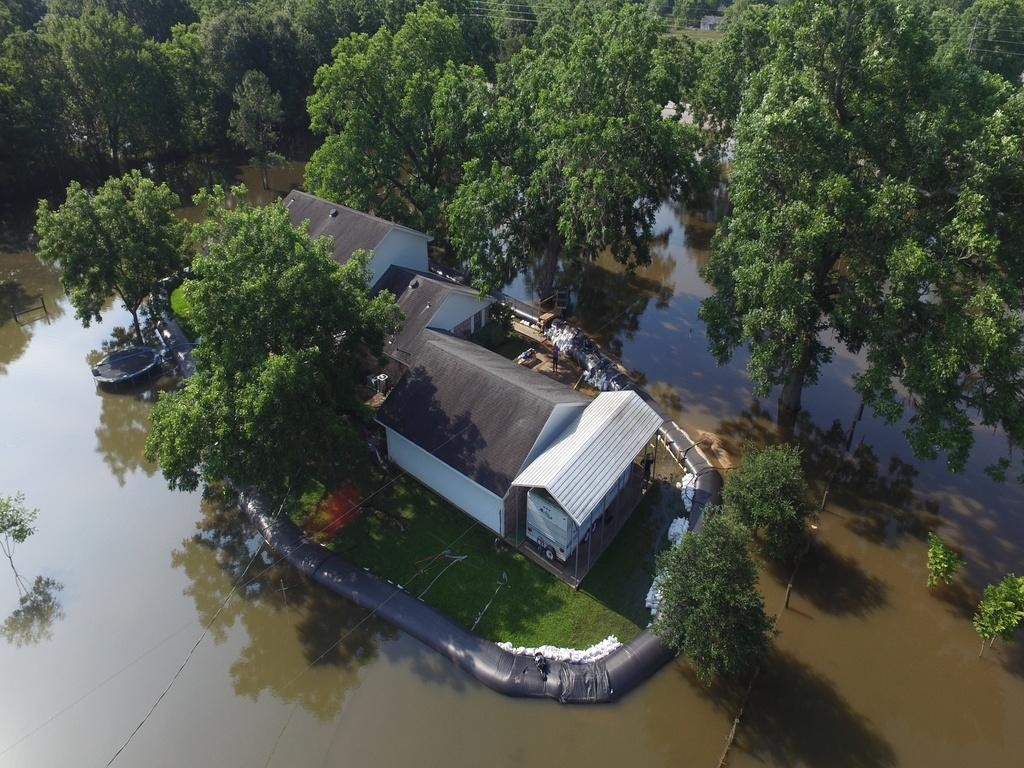
He knew that if several feet of water entered his home, the damage could be devastating.
Furniture, flooring, walls, electrical systems, and personal belongings could all be destroyed.
But instead of simply waiting for the floodwaters to arrive, Randy started searching for a solution.
And he found something unusual on the internet.
The $8,300 Purchase That Made Everyone Laugh
While researching flood protection methods, Randy discovered a product called AquaDam.
Unlike traditional sandbags, AquaDam uses large tubes made from plastic and fabric that are filled with water.
Once filled, the tubes become heavy enough to form a temporary barrier against rising floodwaters.
Randy believed the system might save his house.
He was so convinced that he drove to Louisiana to purchase one.
The barrier cost approximately $8,300.
It measured about 400 feet long and stood 30 inches high when filled.
With help from two other men, Randy began positioning the massive tube around his home.
The installation attracted plenty of attention.
People passing by couldn’t understand why someone would spend so much money surrounding a house with what appeared to be an enormous plastic sausage.
Some neighbors laughed.
But Randy continued working.
He believed the approaching flood was far more serious than people realized.
How the Strange Plastic Barrier Actually Worked
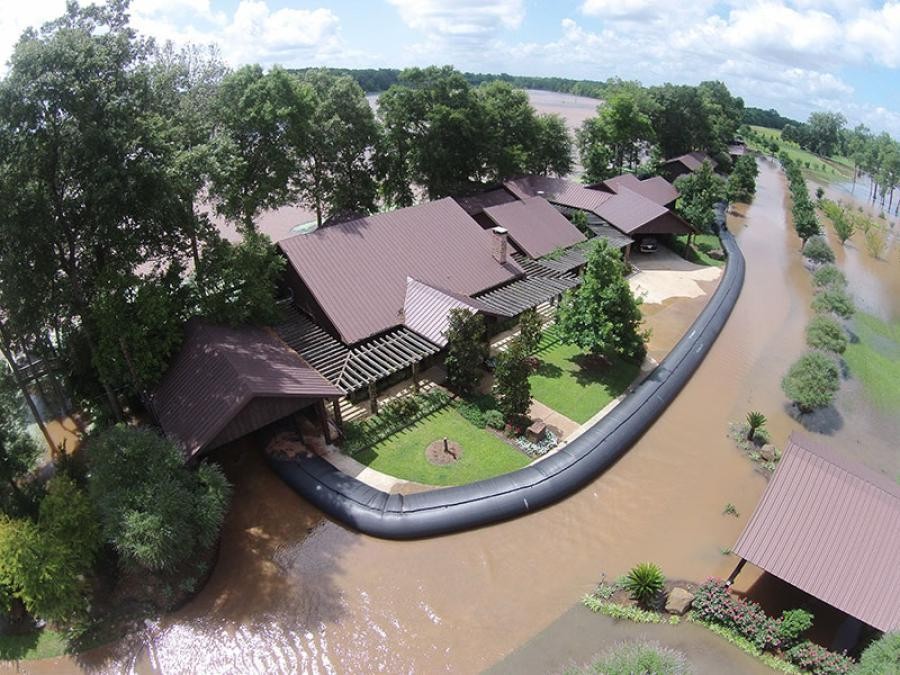
The secret behind AquaDam was surprisingly simple.
Instead of trying to keep water away using piles of sand, the system uses water itself to create a protective wall.
The tubes are filled until they become heavy and stable.
Their flexible construction allows them to conform to the ground, helping reduce gaps through which floodwater might pass.
The weight of the water inside keeps the barrier in position under suitable conditions.
Randy and his helpers spent hours filling and arranging the tubes.
When they finished, his home was surrounded by a continuous temporary flood barrier.
From above, the house appeared to sit inside an enormous black ring.
It looked strange.
But Randy hoped it would work.
And soon, the barrier would face its ultimate test.
The Floodwaters Finally Arrived
As the Brazos River continued rising, water spread through the surrounding area.
Many families were forced to leave their homes.
Others watched helplessly as floodwaters approached their properties.
At Randy’s house, the water began climbing against the AquaDam.
The level rose higher and higher.
Eventually, it reached approximately 27 inches.
That was dangerously close to the top of his 30-inch barrier.
Only three inches separated the floodwater from the height of the protective wall.
But the AquaDam held.
The water did not overtop the barrier.
And according to Randy, it did not seep through.
While the surrounding area was flooded, his home remained dry.
The unusual invention had done exactly what he hoped it would do.
The Neighbors Weren’t Laughing Anymore
After the flood, Randy spoke with local television reporters about his decision.
He remembered how people had reacted while he was installing the barrier.
At first, they thought he was crazy.
But after seeing the results, their opinions changed.
The same neighbors who had questioned his unusual purchase were now impressed by what the system had accomplished.
For Randy, the investment was worth every dollar.
He estimated that two feet of water inside his house could have resulted in approximately $150,000 in repairs.
Compared with that possibility, spending $8,300 on a protective barrier seemed like a reasonable decision.
He had invested a relatively small amount to protect something far more valuable.
His home.
Why His Story Became Famous
Photographs of Randy’s house surrounded by the enormous black barrier quickly attracted attention.
The story was covered by television stations and news websites across the United States.
People were fascinated by the idea of using water to fight water.
The AquaDam looked unusual, but its underlying principle was practical.
A heavy, water-filled barrier can temporarily redirect or hold back floodwater when properly selected and installed.
However, these systems have limitations.
They must be suitable for the expected flood depth, ground conditions, and water pressure.
If floodwater rises above the barrier, protection can fail.
They also cannot replace evacuation orders or professional flood safety advice.
Randy’s experience demonstrated what such a system could accomplish under the right circumstances.
An $8,300 Decision That May Have Saved $150,000
Randy Wagner’s story remains a fascinating example of preparation and unconventional thinking.
He recognized a serious threat.
He researched a possible solution.
And he acted before the situation became an emergency.
Although others questioned his decision, he continued because he believed the investment could protect his family and property.
When the floodwaters arrived, his preparation paid off.
The man who had been laughed at for surrounding his house with plastic ended up keeping his home dry while floodwaters covered the surrounding area.
Sometimes the smartest solution is the one that looks the strangest at first.
And in Randy’s case, an $8,300 investment may have prevented a repair bill many times larger.