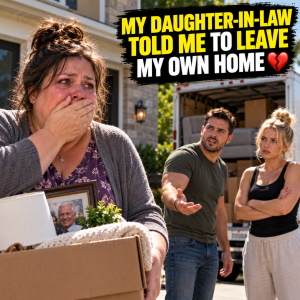
Three weeks after my husband died, my daughter-in-law put my belongings in boxes and told me I had until Sunday to leave my own home.
My son stood beside her.
And said nothing.
I’m Patricia. I’m 61, and I was married to my husband, George, for thirty-four years.
We lived in a quiet suburb outside Nashville, Tennessee.
George had bought our house several years before we met, but after we married, it became our family home.
It’s where we raised our only son, Ethan.
When George died unexpectedly from a heart attack, I could barely function.
Ethan and his wife, Kayla, started coming over almost every day.
At first, I was grateful.
Kayla cooked.
Ethan handled phone calls.
They helped me sort through paperwork.
Then something changed.
One afternoon, Kayla walked through the house pointing at things.
“That dining table could probably sell for $2,000.”
I stared at her.
“What?”
“I’m just saying. It’s too big for wherever you move next.”
I thought I’d misunderstood her.
“I’m not moving.”
She looked surprised.
That evening, Ethan explained what she meant.
Because George had originally bought the house before our marriage, Ethan believed he’d inherited it.
“You can stay for a while, Mom,” he said. “Obviously.”
“For a while?”
He sighed.
“Kayla and I have two kids. We need the space more than you do.”
I couldn’t believe what I was hearing.
I’d buried my husband less than a month earlier.
Now my own son was discussing who needed my bedroom more.
I told him the conversation was over.
Two days later, I went grocery shopping.
When I returned, there was a moving truck in my driveway.
Kayla was carrying a box out of my house.
I ran toward her.
“What are you doing?”
She barely looked at me.
“Helping you.”
I went inside.
Boxes were everywhere.
My clothes.
My books.
My wedding photographs.
Even the framed picture of George that had been sitting beside our bed.
I found Ethan in the living room.
“Put everything back.”
“Mom—”
“NOW.”
Kayla walked in behind me.
“You need to accept reality, Patricia.”
I turned around.
She crossed her arms.
“This isn’t your house anymore.”
Then she told me they’d already spoken to a real estate agent.
They wanted to renovate the kitchen, sell the property, and use part of the money as a down payment on a larger home.
My hands started shaking.
“You’ve already decided what you’re doing with my husband’s house?”
“Our house,” Kayla corrected me.
That’s when something inside me snapped.
I picked up the box containing George’s photograph.
Then I noticed an envelope underneath it.
My name was written across the front in George’s handwriting.
I had never seen it before.
“Where did this come from?”
Ethan’s expression changed.
Kayla quickly reached for it.
“It’s probably nothing.”
I pulled it away from her.
“Why was this in the box?”
Neither of them answered.
I opened the envelope.
Inside was a business card.
George’s attorney.
And four words written underneath:
Patricia, call him first.
I looked at Ethan.
His face had gone pale.
I walked outside and made the call.
The attorney answered.
When I explained what was happening, he became very quiet.
Then he said:
“Patricia, your son has misunderstood what his father left him.”
I looked through the window at Ethan and Kayla.
“What do you mean?”
The attorney replied:
“Don’t leave that house. I’ll be there tomorrow morning with George’s documents.”
The next morning, Kayla was smiling when the attorney arrived.
Twenty minutes later, she wasn’t smiling anymore.
And my son was asking me not to tell anyone what they’d done.
George’s attorney arrived at 9:30 the next morning.
Ethan and Kayla were waiting in the kitchen.
Kayla seemed completely confident.
She even made coffee.
The attorney sat down and placed a thick folder on the table.
Ethan spoke first.
“Dad owned the house before he married Mom. I’m his son. It’s pretty straightforward.”
The attorney looked at him.
“No, Ethan. It isn’t.”
Then he opened the folder.
Several years earlier, George had updated his estate plan.
He knew exactly what he wanted.
I was his wife.
He wanted me protected.
The house was not simply going to Ethan after George’s death as Ethan had assumed.
George had arranged his affairs so that I would retain the rights and ownership interests documented for me, and Ethan could not simply force me out and sell the property.
Kayla stopped smiling.
“But Ethan is his only child.”
“That doesn’t give him the right to remove Patricia from her home.”
Ethan looked confused.
Then angry.
“Dad told me I’d be taken care of.”
“You were.”
The attorney pulled out another document.
George had left Ethan a separate inheritance.
$85,000.
Ethan stared at the paper.
I didn’t understand why he looked terrified instead of relieved.
Then the attorney asked:
“Have you accessed any estate funds yet?”
Silence.
I looked at Ethan.
“What does he mean?”
Kayla suddenly stood up.
“This has nothing to do with the house.”
The attorney looked directly at her.
“Sit down.”
That’s when everything came out.
Ethan had found paperwork showing that his father had left money for him.
Instead of waiting for the estate process to be completed properly, he and Kayla had already made financial commitments based on money they expected to receive.
A new SUV.
Credit card debt.
A deposit on another property.
And they had been counting on selling my home to cover the rest.
That’s why they needed me gone so quickly.
It wasn’t because they needed more space for their children.
They needed money.
I looked at my son.
“You were throwing me out three weeks after your father died because you needed to pay your bills?”
“Mom, it’s not like that.”
“What is it like?”
He couldn’t answer.
Then Kayla made things worse.
“You don’t need a house this big anyway.”
The room went silent.
I looked at her.
“You’re right about one thing.”
She waited.
“This house is too big.”
For a second, she looked hopeful.
Then I continued.
“Too big for people who treat me like this.”
I told them to remove every box they’d packed and put my belongings back exactly where they’d found them.
Then I asked them to leave.
Kayla started arguing.
Ethan tried apologizing.
I didn’t change my mind.
Over the following months, the estate was handled properly through the attorneys.
Ethan received what his father had legally left him.
Not my house.
Not my furniture.
Not my savings.
And not control over my life.
I changed the locks.
I also changed the people authorized to help with my finances and estate.
Ethan and I didn’t speak for nearly five months.
Eventually, he came alone.
No Kayla.
He stood on the porch and apologized.
Not the kind of apology that starts with excuses.
A real one.
He admitted that money had changed the way he’d looked at everything.
I listened.
Then he asked:
“Can you forgive me?”
“I can forgive you.”
He started crying.
Then I added:
“But forgiveness and trust aren’t the same thing.”
He nodded.
I didn’t invite him inside that day.
Maybe that sounds harsh.
But I’d learned something important.
Being a mother doesn’t mean accepting anything your children do to you.
Today, I’m still living in the house George and I shared.
His photograph is back beside my bed.
The dining table Kayla wanted to sell is still in my dining room.
And every Sunday morning, I drink my coffee on the porch George built with his own hands.
My daughter-in-law once told me I needed to accept reality.
Eventually, I did.
Just not the reality she had planned for me.